“Open design practices, communities, and technologies signal shifting relations in the world of design – between experts and novices, between proprietary and open access to information, and between producers and consumers of media and technologies – to name just a few.”
“Rather than just bemoaning the restrictions placed on users by institutionalized technological systems, engaged makers have the increasing ability and opportunity to constitute and construct alternatives. Such alternatives do not always replace the existing systems, nor are they often intended to. Instead, these material interventions provide insubstantiations of how the relationship between society and technology might be otherwise constructed. Again, this is particularly true for complex hardware and software solutions OPEN EVERYTHING that have traditionally been seen to require proprietary and closed development in order to ensure success.”
“One claim he makes is that these practices can result in different products and services than those currently produced through proprietary market forces. For Benkler, commons-based peer production can result in more than just open but substantively similar products and services. Instead, these practices can produce entirely novel results – and more importantly, they can serve audiences and needs that are under-addressed by the marketplace.”
“These developments place designers at the core of a new series of ethico-aesthetic conflicts, giving them a key role to play in the negotiation of competing futures, perspectives, and timescales of sustainability.”
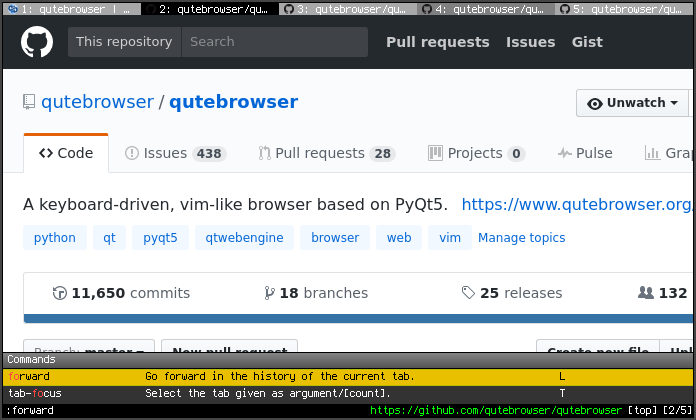
"The qutebrowser project is a web browser for power users, focused on keyboard usage. Its inspired by the vim editor and similar to projects like Tridactyl, Vimperator or Vimium.
As part of the browser, there are various internal web pages, e.g. to view bookmarks or history. The design of those pages is fairly inconsistent and could be improved."
“Open design is a necessary part of this development, but not just because it democratizes or ‘opens’ design to the masses. Rather than replacing professional design expertise and skill, our sense is that by encouraging and supporting design methodologies for non-traditional design ends – such as the socio-technical critique that is the main goal of critical making – open design helps bring about a kind of socio-technical literacy that is necessary to reconnect materiality and morality. This, ultimately, may be the most important consequence of open design.”